

Newsletter 2026.3 Index
Theme : "The Eleventh JSME-KSME Thermal and Fluids Engineering Conference (TFEC11) "
|
Post-Lecture Summary: Engine Knock Prediction – Building on Combustion Fundamentals
 |
Kaoru Maruta, |
Abstract
This invited lecture summarized a dimension-reduction framework for knock prediction in spark-ignition engines, combining DNS, theory, and engine experiments. The key idea is to describe engine knock not only as a device-specific phenomenon, but as the behavior of reaction waves in highly preheated premixed mixtures, characterized in pressure–temperature space.
Engine knock in real engines is inherently three-dimensional, involving complex chamber geometry, turbulence, and cycle-to-cycle variations, so direct fully resolved DNS is practically impossible. To overcome this, we exploited a quasi-two-dimensional constant-volume experiment 1 on n‑heptane and performed two-dimensional DNS using a high-fidelity SIP-based kinetic mechanism 2 and an efficient reactive-flow solver 3. Despite requiring about three months of computation, the two-dimensional DNS 4 quantitatively reproduced the entire knocking process of the experiment. Analysis showed that the leading reaction front remained a strongly preheated premixed flame, which, as chemical reactions in the preheat zone intensified at high temperature, transitioned to global autoignition.
By returning to the governing equations and systematically varying the initial temperature, we found an upper temperature limit above which a steady premixed flame cannot exist; crossing this boundary inevitably leads to a transition from flame propagation to full-volume autoignition. We termed this Explosive Transition of
Deflagration (ETD) 5. This led to the viewpoint that, for a given mixture and pressure, the onset temperature of knock is fundamentally predetermined (Fig. 1).
Using this concept, one-dimensional DNS was conducted for PRF80, 90, and 100 to efficiently identify knock-onset conditions and their relation to ETD (Fig. 2) 6. Knock onset was consistently found 80–90 K below the ETD temperature, and occurred later and at higher temperature and pressure with increasing RON. Finally, CFR engine tests with the same PRFs, conducted in collaboration with ENEOS 7, showed that knock onset temperatures clustered in a narrow 1060–1200 K range and shifted slightly higher with RON, despite large differences in pressure and compression ratio (Fig. 3). This supports the idea that knock is governed by fuel-specific temperature thresholds and demonstrates that the dimension-reduction framework retains validity under realistic engine conditions.
Key words
Fluids visualization, Electrical impedance tomography (EIT), Startup
Figures
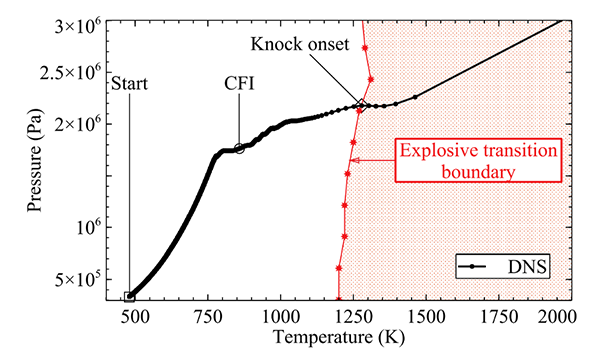
Fig. 1. Temperature and pressure trajectory of unburned mixture in the 2D DNS[23], shown with the flame existence limit [25]. The red line, labeled as the “Explosive transition boundary,” represents the upper temperature limit for flame existence determined from 1D planar premixed flame simulations. The start of 2D DNS and the timings of the cool flame ignition (CFI) and the knock onset are also shown.
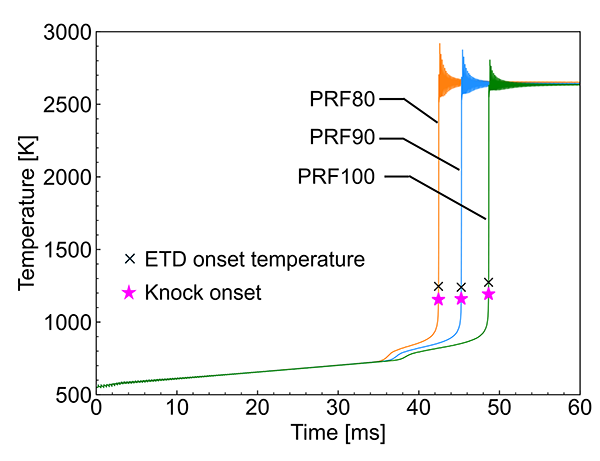
(a)Temperature
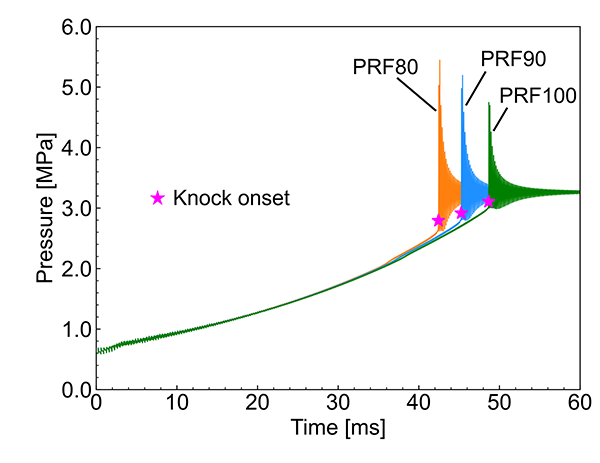
(b)Pressure
Fig. 2. (a) Temperature and (b) pressure history for the case of PRF80, PRF90, and PRF100. The star symbols indicate knock onset timings, and the cross symbols indicate ETD onset temperatures.
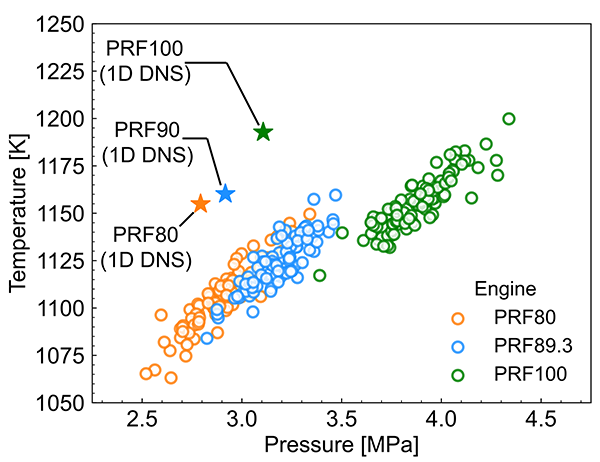
Figure 3. Comparison of knock onset conditions from 1D DNS and CFR engine tests in pressure-temperature (P-T) diagrams, focuses on the knock onset points. The knock onset conditions from 1D DNS are indicated by star symbols, while those from CFR engine tests are shown as circle symbols.