

Newsletter 2026.3 Index
Theme : "The Eleventh JSME-KSME Thermal and Fluids Engineering Conference (TFEC11) "
|
Effect of a sidewall height on the instability of an inclined falling liquid film in a minichannel
 |
 |
 |
 |
| Shogo Matsui Yokohama National University |
Georg F. Dietze Keio University |
Koichi Nishino Yokohama National University |
Misa Ishimura Yokohama National University |
Abstract
This study investigates the influence of sidewall height on the instability of gravity-driven falling liquid films in a 10-mm-wide minichannel. Surface waves induced by the Kapitza long-wave instability enhance transport phenomena in falling films; however, when channels are miniaturized, sidewall effects become significant. If the wall height is smaller than the amount of theoretical capillary rise and basic film thickness, the meniscus is physically constrained at the wall corner, potentially modifying both the basic state interface profile and the flow stability.
Fig. 1 illustrates the experimental configuration. Pure water at 22 °C was supplied to an inclined channel (β = 10°), corresponding to a liquid Reynolds number of ReL = 71.3. The channel width was fixed at 10 mm, while the sidewall height was varied as H = 0.5, 0.7, and 1.0 mm. The spanwise interface profiles measured by a confocal chromatic imaging (CCI) sensor are shown in Fig. 2. For H = 0.5 mm, no capillary rise occurred, whereas increasing H enhanced the meniscus curvature near the walls. Surface wave development under imposed disturbances is presented in Fig. 3. For H = 0.5 mm, typical Kapitza wave evolution was observed, representing the first observation of Kapitza instability in such a narrow channel. Spatial growth rates obtained experimentally are summarized in Fig. 4 and compared with those from two-dimensional linear stability analysis (2D LSA), which ignores sidewall effects. The experiments consistently show lower growth rates than in 2D LSA, and increasing the wall height further reduces disturbance amplification. These results demonstrate that sidewall geometry serves as an effective parameter for stabilizing falling liquid films in compact channel designs.
Key words
Kapitza instability, surface waves, minichannel, wetting, sidewall
Figures
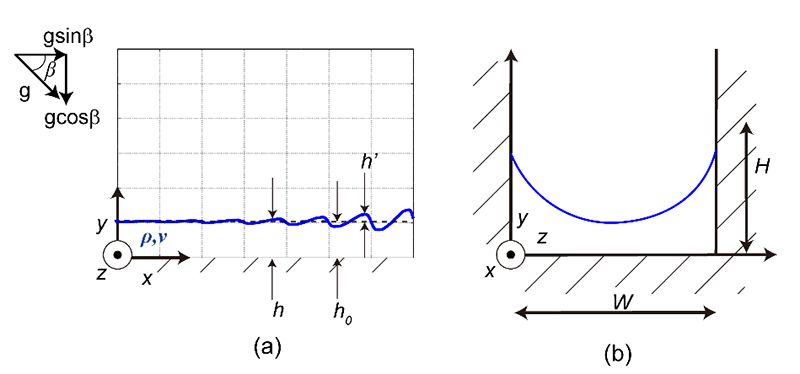
Fig. 1 Falling liquid film on an inclined plane: (a) side view (b) cross-sectional view.
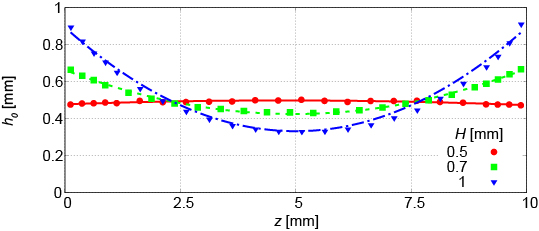
Fig. 2 Spanwise profiles of the liquid film obtained by the CCI sensor (symbols) and fitted quadratic functions (lines).
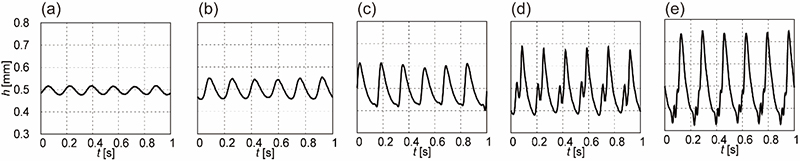
Fig. 3 Streamwise development of surface waves at the channel center ( mm) under an imposed disturbance frequency
  Hz. The measurement positions are (a)
  mm, (b)
  mm, (c)
  mm, (d)
  mm, and (e)
  mm.
mm.
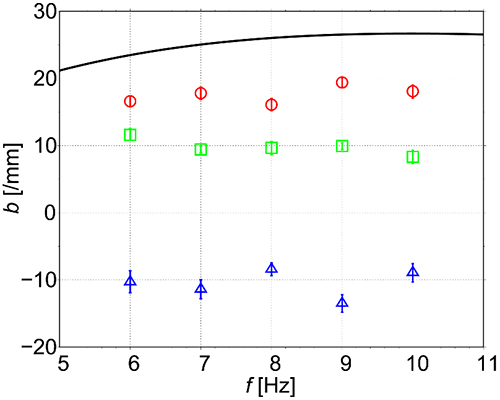
Fig. 4 Spatial growth rate as a function of disturbance frequency. The black solid line represents the prediction from two-dimensional linear stability analysis (LSA). Experimental results are shown by red circles ( mm), green squares (
 mm), and blue triangles (
 mm).
mm).