

Newsletter 2026.3 Index
Theme : "The Eleventh JSME-KSME Thermal and Fluids Engineering Conference (TFEC11) "
|
Experimental investigation of combined blowing-suction control on a Clark-Y airfoil
 |
 |
| Senri MIURA Keio University |
Koji FUKAGATA Keio University |
Abstract
Improving energy efficiency in aviation is a critical challenge that requires effective drag reduction techniques. Uniform Blowing (UB) and Uniform Suction (US) are promising methods where air is minimally injected or removed from airfoil surfaces to manipulate the boundary layer, as illustrated in Fig. 1. While UB reduces friction drag, it often leads to an unintended increase in pressure drag. To address this, the present study proposes a combined control strategy to enhance the lift-to-drag ratio of a Clark-Y airfoil by simultaneously applying UB near the leading edge of the lower surface and US near the trailing edge of the upper surface.
Figure 2 shows the schematic of the experimental setup used in a low-turbulence wind tunnel with a Clark-Y airfoil model. Experiments were performed at a Reynolds number of  and a zero-degree angle of attack, with blowing and suction velocities maintained at 0.39% of the freestream velocity. Wake velocity profiles were measured using hot-wire anemometry at a downstream position of
  . As can be seen in the close-up view in Fig. 3, the velocity deficit region for the combined control case shifted downward relative to the no-control case. This downward shift indicates flow deflection, qualitatively suggesting an increase in lift.
To quantify the aerodynamic impact, the total drag was calculated based on the momentum flux through the control volume depicted in Fig. 4. The experimental analysis revealed that the total drag decreased by 5.2% under the combined control. This result indicates that the adverse effect on drag is minimal compared to the potential lift enhancement. These findings suggest that the combined UB/US control strategy is a practical and effective approach for improving the lift-to-drag ratio of airfoils in cruise conditions.
Key words
Airfoil, Wind-tunnel Experiment, Friction Drag Reduction, Blowing, Suction
Figures
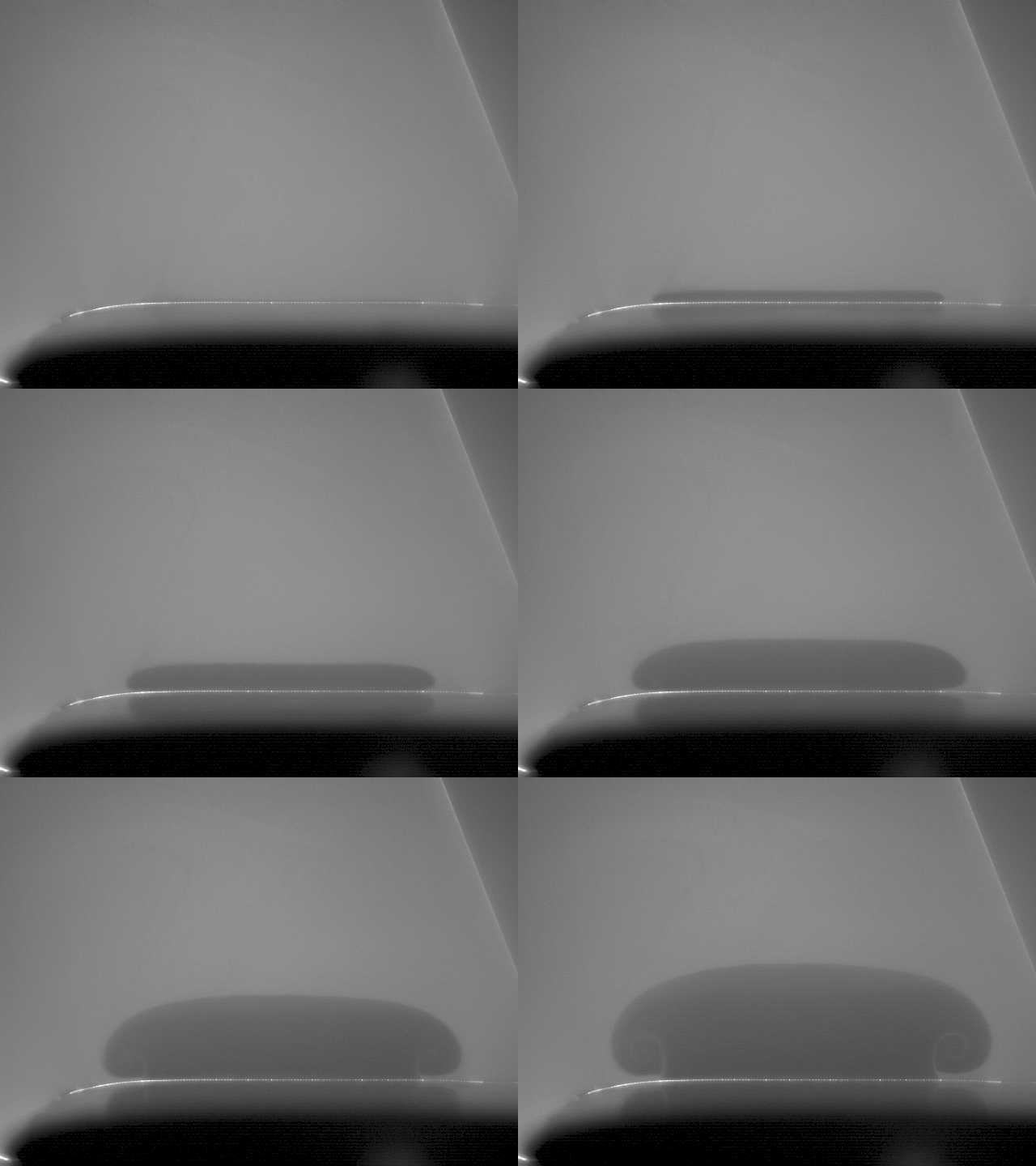
Fig. 1 Uniform blowing on an airfoil surface.
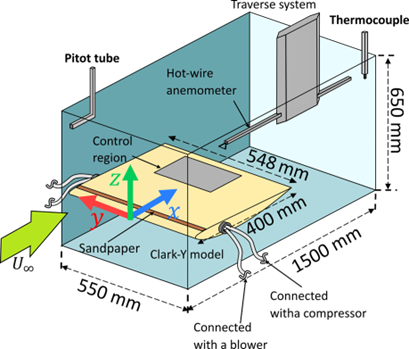
Fig. 2 Schematic of experimental setup.
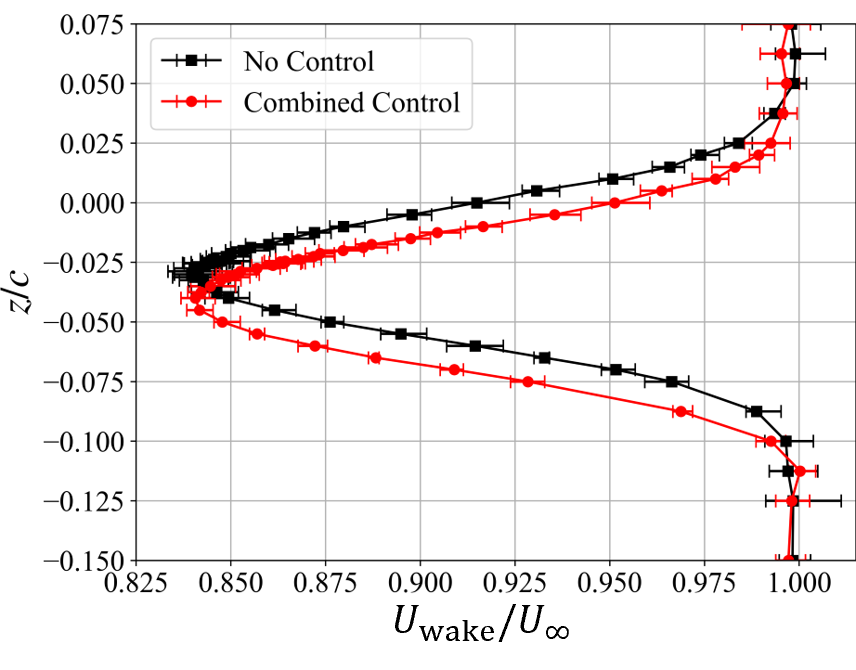
Fig. 3 Wake velocity profile.
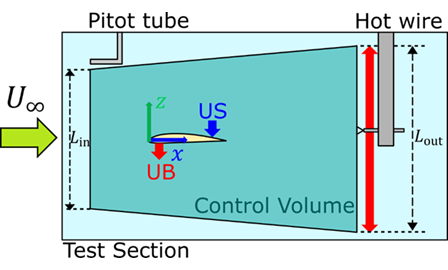
Fig. 4 Schematic of the control volume.