

Newsletter 2026.3 Index
Theme : "The Eleventh JSME-KSME Thermal and Fluids Engineering Conference (TFEC11) "
|
Turbulent drag reduction effects by streamwise traveling waves with spanwise phase shifts
 |
 |
 |
 |
| Kyohei OISHI Keio University |
Senri MIURA Keio University |
Yusuke NABAE Tokyo University of Science |
Koji FUKAGATA Keio University |
Abstract
Reducing fluid drag, especially friction drag, is expected to enhance energy efficiency, thereby helping to mitigate the environmental issues such as global warming. Streamwise traveling wave-like wall deformation is a promising active control method for reducing the friction drag. Although previous studies utilizing spanwise-uniform traveling waves (Fig. 1 a) achieved a significant drag reduction of 60.5%, the resulting flow field exhibited instability driven by recurring cycles of laminarization and re-transition to turbulence. This instability stems from near-wall flow reversal, which forms velocity inflection points and triggers inflectional instability.
To achieve significant drag reduction in a stable manner, we propose a streamwise traveling wave incorporating a spanwise phase shift. The concept of the proposed control is schematically illustrated in Fig. 1 (b). This phase variation generates spanwise disturbances that mitigate the inflectional instability by maintaining momentum transport to the near-wall region.
As shown in Fig. 2 , the proposed control involves five control parameters. Specifically, three parameters are associated with the streamwise traveling wave: the velocity amplitude  , the phase speed
  , and the streamwise wavelength
  (Fig. 2 a). On the other hand, two parameters are specific to the proposed control method: the phase shift amplitude
  and the spanwise wavelength
  (Fig. 2 b).
According to a parametric study of the phase shift amplitude and spanwise wavelength, a sufficiently large phase shift stabilizes the flow field while retaining a large drag reduction effect. Consequently, the maximum drag reduction and net energy saving rates attained are and
and  , respectively. These values surpass the results of previous studies under stable flow conditions by more than 10%.
To elucidate the mechanism of the enhanced drag reduction, we analyzed the turbulent Reynolds shear stress (RSS) and visualized vortical structures. Figure 3 illustrates the turbulent RSS profiles at  , including the optimal case (
 ) that yielded the maximum net energy saving rate. This result reveals that the turbulent RSS is significantly reduced near the wall, which contributes to the large drag reduction. To investigate the cause of this reduction, Fig. 4 presents the visualization of the vortical structures. As shown in Fig. 4, quasi-streamwise vortices are substantially suppressed and localized in the spanwise direction. Consequently, we conclude that the suppression and localization of these vortices are the primary factors driving the superior drag reduction performance.
Key words
Turbulent channel flow, Direct numerical simulation, Drag reduction, Streamwise traveling wave, Wall deformation
Figures
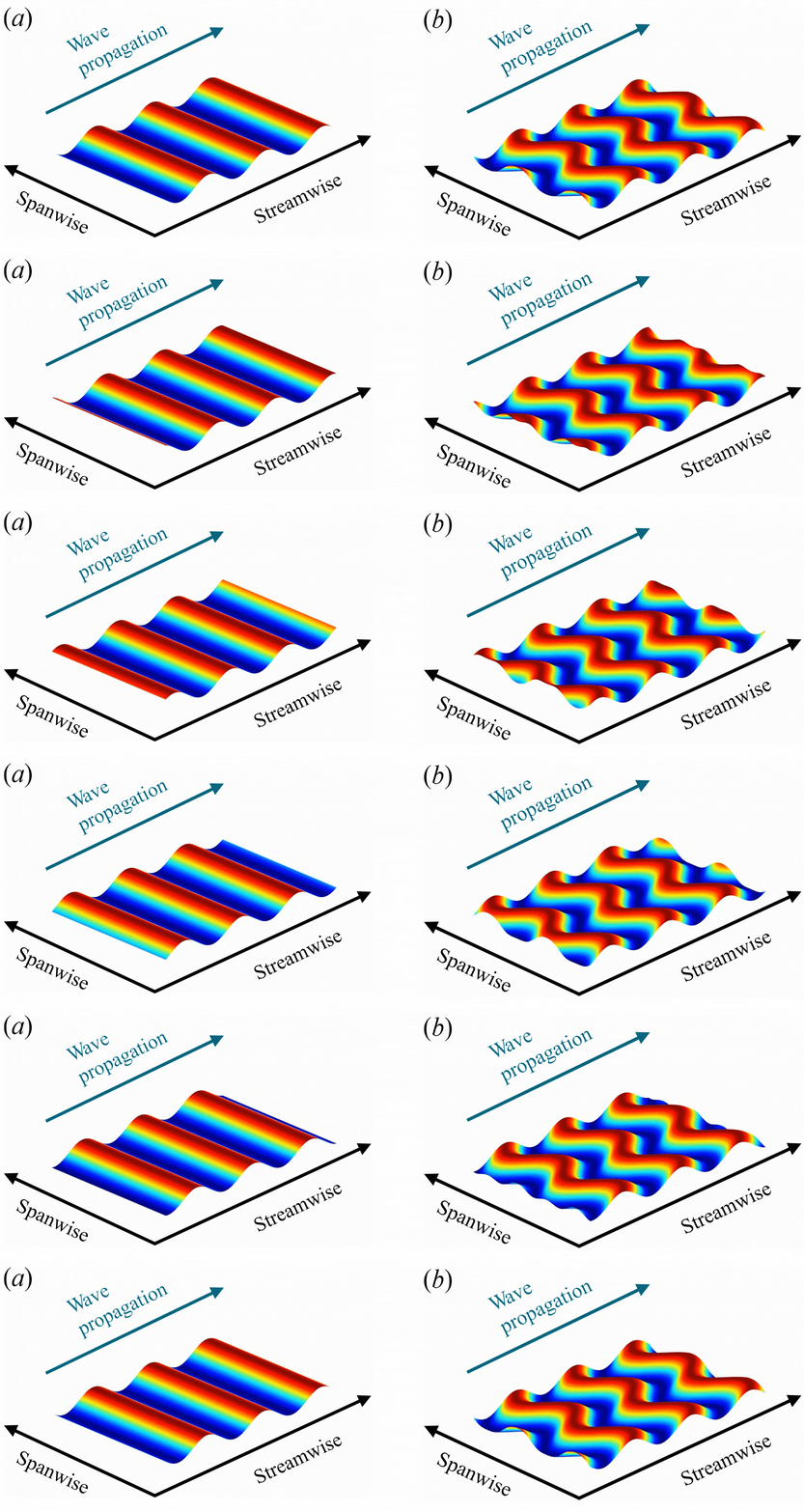
Fig.1 Schematic of streamwise traveling wave-like wall deformation: (a) spanwise-uniform[1] ; (b) with spanwise phase shift.
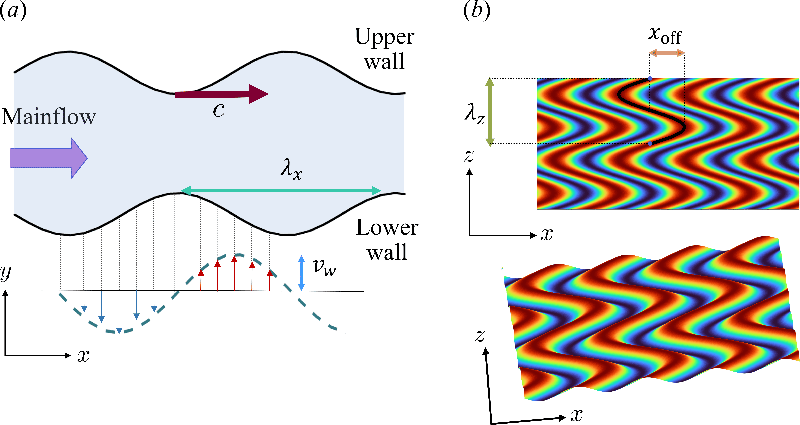
Fig.2 Schematic of control parameters: (a) the parameters for the conventional streamwise traveling wave; (b) the parameters to determine the form of the spanwise phase shift.
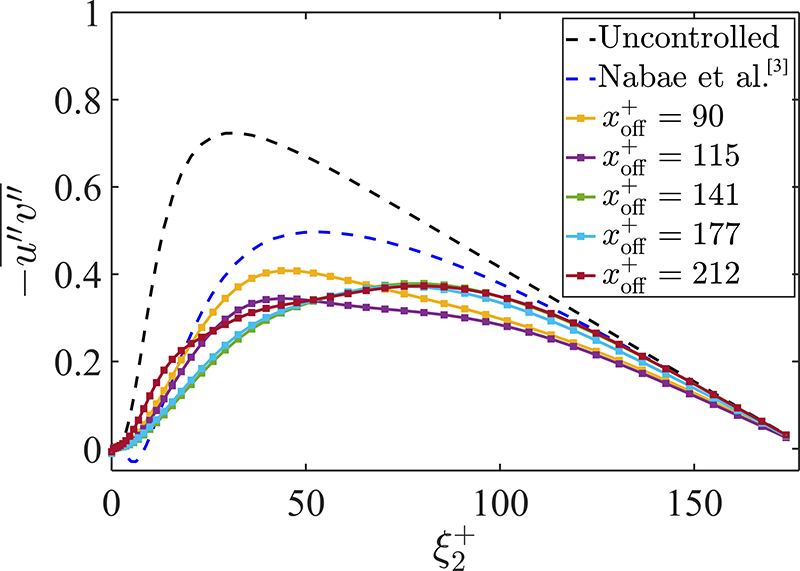
Fig.3 Turbulent RSS in the case of .
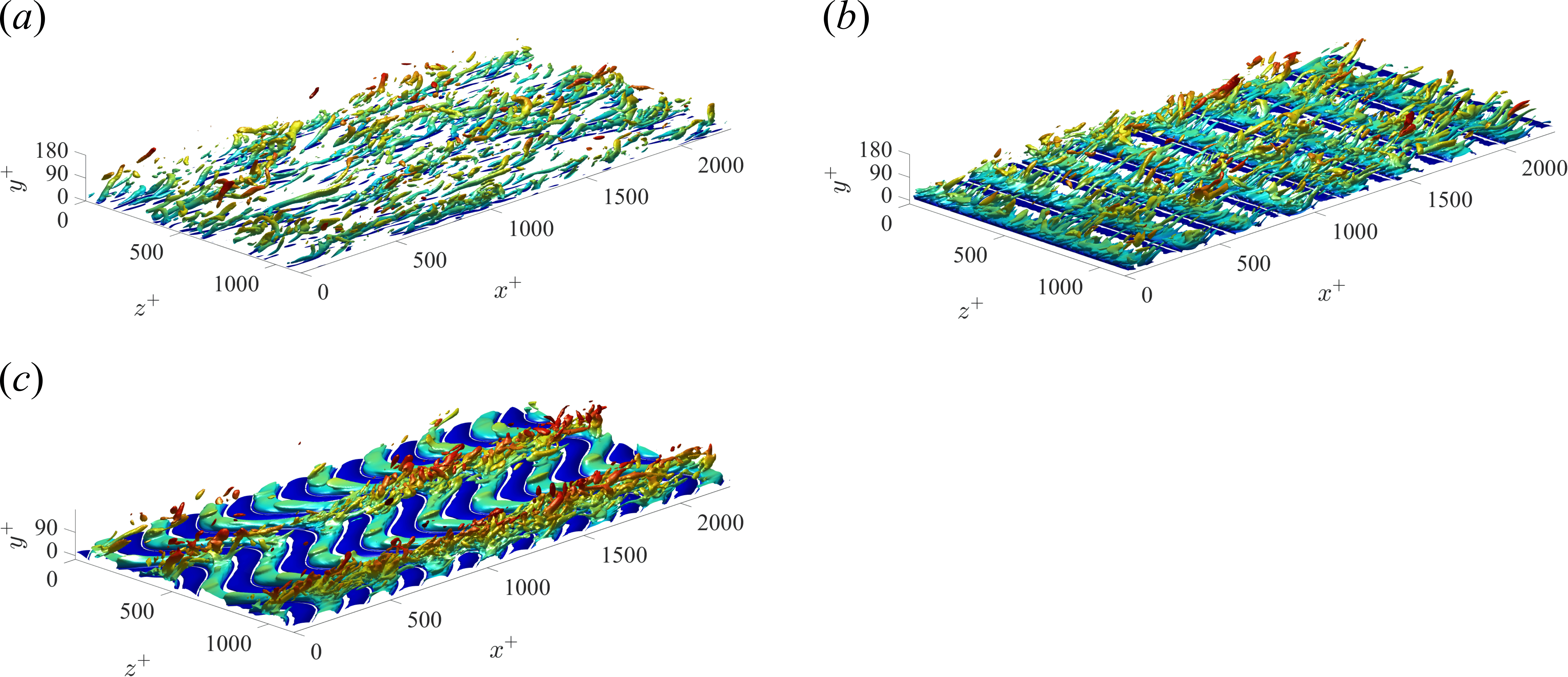
Fig. 4 Instantaneous vortical structures identified using the Q criterion: (a) the uncontrolled case; (b) the maximum drag reduction case in Nabae et al. (2020); (c) maximum net energy saving case ( ). Color represents the wall-normal coordinate in the real space.